
Universal Pumping | High Pressure Pumps
High Pressure Pumps for Difficult to Pump Slurry, Sludge, and Food Waste.
Buying Barite Drywall Radiation Shielding requires more than comparing prices or board thickness. The right product must match the room’s radiation source, workload, distance, occupancy, and design requirements. Medical physicist Dr. Michael G. Stabin offers a useful principle: “Shielding should be designed from measured workload, distance, and occupancy, not guesswork.” That advice deserves attention.
This guide introduces five practical checks for selecting Barite Drywall Radiation Shielding. It examines barite density, verified attenuation data, panel dimensions, joint treatment, and installation quality. A heavy panel may look reassuring beside a concrete wall. Still, weight alone does not prove adequate protection. Ask for independent test reports, technical datasheets, and clear lead-equivalence information. Confirm whether the product has been tested under conditions similar to your facility.
Details matter. Gaps around electrical boxes can weaken a carefully planned barrier. Poorly sealed seams can create hidden pathways. Moisture exposure may also affect long-term performance, depending on the board construction and location. These points are easy to overlook.
The safest purchase usually begins with a qualified radiation-shielding designer, not a sales brochure. Request a documented shielding calculation before ordering materials. Check local building, occupational safety, and medical-facility requirements with the responsible authority. Product availability may influence the final choice, but it should not replace technical judgment.
Even experienced buyers can make assumptions. That is the uncomfortable part. A cheaper board may become expensive after corrections, delays, or removal. Careful verification protects patients, workers, contractors, and the project budget.
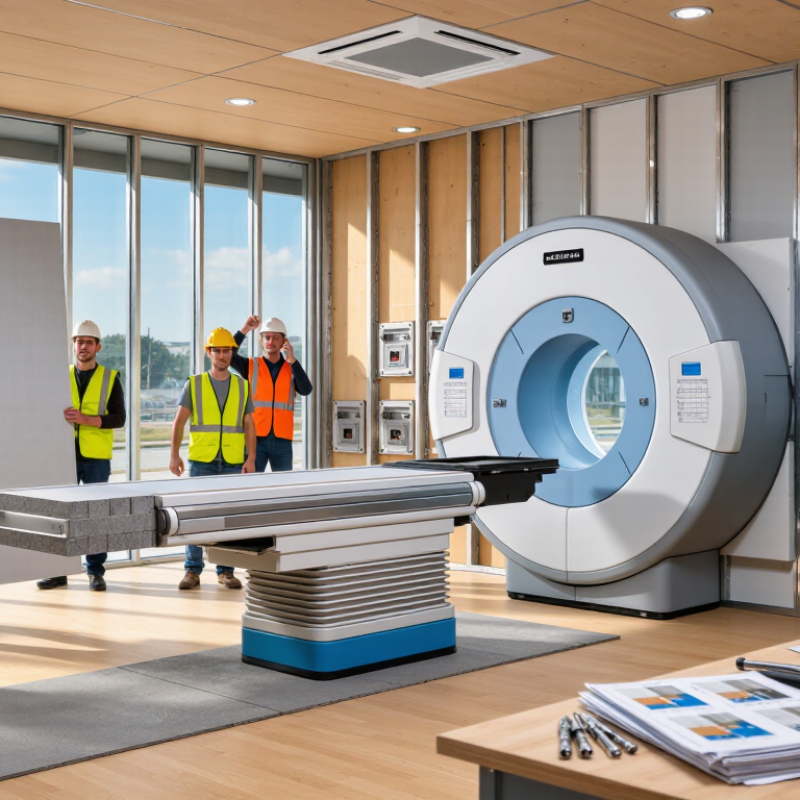
When buying barite drywall radiation shielding, compare density before comparing price. Typical panels range from 2.3 to 3.5 g/cm³, depending on barite content, thickness, and manufacturing method. Higher density usually means greater mass per square meter, but it does not automatically prove better shielding. A practical mistake is judging performance from density alone. I once considered that shortcut reasonable; it is not.
Check five details: panel density, thickness, tested attenuation, joint treatment, and installation weight. USGS Mineral Commodity Summaries 2024 reports barite specific gravity near 4.2–4.5, explaining why barite-rich panels can be substantially heavier than standard gypsum board. However, panel density remains lower because gypsum and binders occupy part of the structure. Ask for a current test report, not only a sales specification.
NCRP Report No. 147 evaluates shielding through workload, beam energy, distance, and occupancy. Therefore, a 3.5 g/cm³ panel may be unsuitable if joints, doors, or penetrations remain weak points. Inspect edges closely. Measure actual thickness and confirm compatible framing capacity. ASTM C1396/C1396M can help verify gypsum panel requirements, but it does not replace project-specific radiation calculations. Density figures can vary between batches, so request documented tolerance data. A small mismatch matters.
| Tip | What to Compare | Typical Data or Range | Why It Matters | What to Confirm Before Purchase |
|---|---|---|---|---|
| 1 | Panel density | 2.3–3.5 g/cm³ (2,300–3,500 kg/m³) | Higher bulk density generally provides more shielding mass per unit thickness, but density alone does not determine radiation protection. | Ask whether the stated value is the tested panel density, a minimum specification, or an approximate nominal value. |
| 2 | Panel thickness | Common comparison points: 12.5 mm and 15 mm | Shielding performance depends on the combination of material density and thickness. A thinner, denser panel may not equal the performance of a thicker panel in every design. | Compare products using the same thickness and the same radiation energy or design requirement. |
| 3 | Estimated panel weight | For a 1 m² panel at 12.5 mm thickness: 28.8–43.8 kg/m² | Weight affects wall framing, fasteners, handling, delivery, and installation safety. The estimate is calculated as density × thickness × area. | Check the actual sheet size, declared mass per square metre, substrate capacity, and lifting requirements. |
| 4 | Radiation attenuation data | Must be specified for the intended radiation type, energy, and required protection level | X-ray and gamma-ray shielding performance varies with photon energy, wall construction, joints, openings, and total areal mass. Density is only one design variable. | Request independent test data or a shielding calculation based on the actual room layout and equipment operating conditions. |
| 5 | Installation and quality controls | Review joint treatment, penetrations, edge details, moisture protection, and dimensional tolerances | Gaps, unprotected service penetrations, poorly sealed joints, or damaged boards can reduce the continuity of a shielding barrier. | Confirm installation instructions, inspection procedures, repair methods, storage conditions, and compliance documentation. |
Tip 1—Match the shielding to X-ray energy, not room labels. Barite drywall performance changes with tube potential, filtration, and beam direction. A 70 kVp dental beam is not equivalent to a 120 kVp CT beam. NCRP Report No. 147 states that shielding design must consider workload, use factor, occupancy, and distance. Ask for tested attenuation at your actual kVp range. Generic “lead-equivalent” claims can mislead.
Tip 2—Measure workload honestly. Count weekly examinations, exposure time, and peak operating periods. A quiet imaging room may become busy after renovation. That mistake is common. NCRP 147 and IAEA Safety Reports Series No. 47 both support workload-based calculations rather than fixed wall thickness. Also check the adjacent space. A corridor, office, or waiting area may have different occupancy factors. IAEA SRS-47 identifies distance and occupancy as key inputs for structural shielding decisions.
Tip 3—Use distance as a design tool. Doubling the distance from the X-ray source reduces direct intensity to roughly one-quarter, before shielding effects. Place the control area and frequently occupied workstations farther away when practical. Confirm joints, corners, doors, outlets, and service penetrations with a qualified medical physicist. Barite panels can perform well, but installation gaps can weaken the real barrier. ICRP Publication 103 recommends a 1 mSv annual public dose limit, while local design goals may differ. Cite the applicable regulations and retain the calculation record.
Match shielding to X-ray energy, workload, distance, and occupancy. The chart below demonstrates the inverse-square relationship between distance and relative radiation intensity. It is a planning reference, not a substitute for a room-specific shielding calculation.
Higher tube voltage, measured in kVp, generally produces more penetrating radiation and may require greater shielding performance.
Workload is commonly expressed in mA·min per week. More examinations or longer exposures increase the radiation that must be controlled.
For a point source, intensity decreases approximately with the square of distance: doubling distance reduces intensity to about one-quarter.
Common planning values are 1 for full occupancy, 1/4 for partial occupancy, and 1/16 for occasional occupancy. Confirm the applicable local standard.
Barite drywall thickness, joints, penetrations, doors, and adjacent areas should be specified by a qualified radiation shielding professional.
5 Tips for Buying Barite Drywall Radiation Shielding
A barite drywall panel is not automatically equivalent to lead. The key question is simple: does it provide 0.5 mm Pb equivalence at 100 kVp? Ask for an independent test report that states this exact beam energy. The report should also identify filtration, test geometry, panel thickness, density, and measurement uncertainty. Lead equivalence changes with kVp. A panel tested at 80 kVp may not deliver the same result at 100 kVp.
Check the documentation carefully. NCRP Report No. 147 explains that diagnostic shielding depends on workload, distance, occupancy, and radiation energy. IAEA Safety Reports Series No. 47 also emphasizes site-specific shielding assessments. These reports support the design process, but they do not certify a particular drywall product. The supplier’s data must match your room conditions. A vague claim like “radiation resistant” is not enough.
Look for batch consistency. Barite density can vary across production runs. Ask whether the test sample represents the installed panel, not a laboratory-perfect specimen. Measure joints, fasteners, corners, and service penetrations during installation. Small gaps can undermine a strong panel. This is often overlooked. I have seen projects focus on panel thickness while ignoring door frames and pipe openings. That mistake is expensive to correct. Have a qualified medical physicist review the final shielding plan before purchase and commissioning.
Check the panel thickness against the room’s shielding design, not just the product description. Barite drywall can vary in density, weight, and radiation attenuation. Ask for documented test data and the stated thickness tolerance. A small difference may affect seams and transitions. Do not assume a thicker panel always solves every shielding problem.
Measure joint overlap carefully. Panels should meet with the overlap specified by the shielding designer. Staggered joints can reduce direct paths through the wall. Corners, ceiling connections, and service openings need equal attention.
Watch the details. A narrow exposed gap can weaken an otherwise strong installation.
My practical warning is simple: drawings often look perfect, while cut panels do not.
Review fastener details before purchase. Confirm screw type, spacing, embedment, and permitted locations. Fasteners should not create unprotected paths or damage the panel surface. Ask how joints will be sealed and how outlets, pipes, and inspection windows will be treated.
Check the panel weight against the framing capacity. It is easy to overlook this. Request installation instructions, quality records, and the designer’s approval before ordering.
A qualified radiation shielding physicist or engineer should verify the final layout for the equipment’s operating energy. Even careful buyers can miss a small penetration.
Measure twice, then question the assumption.
Buying barite drywall requires more than checking its weight or a radiation-shielding claim. Ask for independent ASTM test reports showing the panel’s composition, thickness, density, and attenuation results. Testing should identify the X-ray energy range and exposure conditions. Without those details, a percentage claim means little.
NCRP Report No. 147 explains that medical shielding depends on workload, distance, occupancy, and the protected area. Therefore, one fixed panel thickness cannot suit every room. Request a radiation-protection report prepared from the actual room layout. It should address walls, doors, ceilings, floors, joints, and service penetrations. Small gaps can defeat careful planning.
Fire performance needs separate evidence. Look for assemblies tested under ASTM E119 or UL 263, with the exact layer arrangement and installation method. A panel may resist radiation well but perform differently in a rated wall. Ask for fastener spacing, joint treatment, cutting instructions, and repair procedures. Installation data matters.
Check the installer’s field experience. Review photographs, inspection records, and any measured shielding verification. I would not accept a laboratory report that ignores seams. That is a common weakness. Also compare the report with IAEA shielding guidance and the project physicist’s calculations. Documents can still be incomplete, so have a qualified radiation-protection professional verify the final design before purchase.
Universal Pumping
625 Apache Trail
Woodstock, GA 30189
Mon - Fri | 9:00 AM - 5:00 PM
Universal Pumping is staffed with industry professionals with 20-45 years experience with high pressure pumping systems. We represent only the “elite producers” in pump manufacturing: Britain’s EMS and Germany’s EMMERICH. Our engineering and manufacturing approach is conservative, and we do not use “guess work” in the design or sales of our pumping and filtration equipment.


