

Universal Pumping | High Pressure Pumps
High Pressure Pumps for Difficult to Pump Slurry, Sludge, and Food Waste.
Choosing the right Gas Cylinder Transportation Frame is not a simple purchasing task. Global buyers must consider cylinder size, load capacity, handling equipment, storage conditions, and delivery routes. A frame that performs well in a dry warehouse may fail on uneven roads, during repeated lifting, or in humid coastal environments. Small details matter. Wheel design, weld quality, locking points, and surface protection can affect daily safety and operating costs.
This guide introduces ten transportation frames suitable for different industrial applications. The selection focuses on practical features, including frame stability, cylinder separation, forklift access, crane lifting points, and maintenance requirements. Each option should be checked against the buyer’s cylinder specifications and site procedures. Product photographs can help, but they cannot replace dimensional drawings, inspection records, and direct supplier communication. Ask for evidence.
Experience from industrial handling projects shows that the lowest quoted price is rarely the complete cost. A weak base may require earlier repairs. Poor restraint design may slow loading work. Excessive frame weight may reduce transport efficiency. These issues are easy to overlook. Even experienced teams can miss them when comparing offers quickly. The following overview therefore balances design, usability, durability, and supplier reliability. It also acknowledges an important limitation: no universal frame suits every market or cylinder type. Buyers should verify materials, rated capacity, compatibility, and applicable safety requirements before ordering. Careful evaluation protects workers, equipment, and cargo while supporting more predictable international procurement.
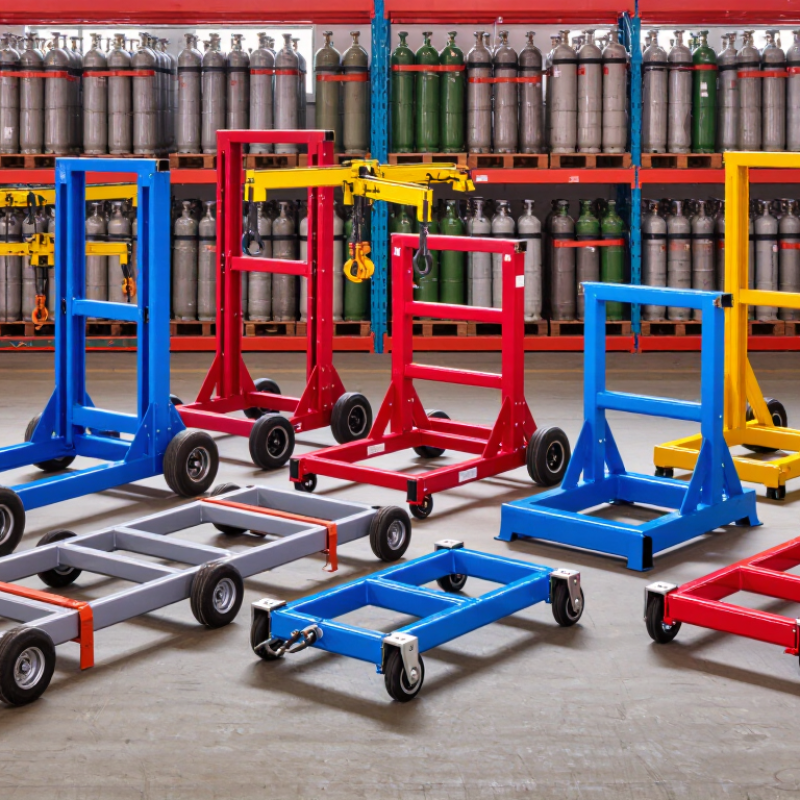
Top 10 Gas Cylinder Transportation Frames for Global Buyers
A useful shortlist starts with gas behavior, cylinder capacity, and certified load rating. The ten frame types include hydrogen tube bundles, oxygen packs, nitrogen packs, argon packs, carbon dioxide racks, helium racks, acetylene frames, LPG cylinder cages, medical-gas frames, and mixed-gas frames. Each design should state cylinder count, water capacity, tare weight, and maximum gross weight. A 20-foot frame may carry several large tubes, while a compact medical frame needs better maneuverability.
IEA’s Global Hydrogen Review 2024 reports that hydrogen demand reached about 97 million tonnes in 2023. That growth increases demand for high-capacity tube frames, but payload calculations remain decisive. ISO 11120 covers refillable seamless steel tubes above 150 litres and up to 3,000 litres. Therefore, hydrogen and nitrogen frames may require different restraints, valve protection, and spacing. Oxygen frames need clean contact surfaces. LPG cages need ventilation and secure upright positioning. Acetylene frames require dedicated separation and handling controls.
UNECE ADR 2025 emphasizes approved packaging, securing, and transport conditions for dangerous goods. Buyers should compare tested load ratings, not only advertised capacity. A frame rated for 3,000 kilograms may become unsuitable after uneven loading or road vibration. Real warehouse experience shows that damaged fork pockets often reveal weak design choices. That detail matters. A practical weakness remains: suppliers may publish capacity clearly, but omit fatigue-test results. Request drawings, inspection records, center-of-gravity data, and regional compliance evidence before purchase. Databases and standards help, yet field verification is still necessary.
Reference frame configurations for common industrial, medical, laboratory, and fuel-gas applications. Dimensions and ratings are practical specification targets for buyer comparison; final designs must be verified against cylinder specifications, lifting methods, transport regulations, and applicable local standards.
| No. | Gas Type | Typical Cylinder Configuration | Cylinder Water Capacity | Nominal Gas / Fuel Capacity | Rated Payload | Overall Frame Size (L × W × H) | Estimated Tare Weight | Frame Material | Primary Restraint Method |
|---|---|---|---|---|---|---|---|---|---|
| 1 | Oxygen (O2) | 12 × high-pressure cylinders | 50 L each (600 L total) | Approximately 120 m3 | 1,200 kg | 1,220 × 1,050 × 1,850 mm | 260 kg | Carbon-steel tube frame with corrosion-resistant finish | Two-tier chains or certified webbing straps |
| 2 | Nitrogen (N2) | 16 × high-pressure cylinders | 50 L each (800 L total) | Approximately 160 m3 | 1,500 kg | 1,350 × 1,100 × 1,900 mm | 310 kg | Structural carbon steel | Individual cylinder pockets with horizontal locking bars |
| 3 | Argon (Ar) | 12 × high-pressure cylinders | 50 L each (600 L total) | Approximately 120 m3 | 1,200 kg | 1,220 × 1,050 × 1,850 mm | 260 kg | Carbon steel or stainless steel contact fittings | Rubber-lined locating rails and two restraint levels |
| 4 | Carbon Dioxide (CO2) | 12 × liquid-service cylinders | 40 L each (480 L total) | Approximately 360 kg of liquid CO2 | 1,100 kg | 1,250 × 1,050 × 1,650 mm | 275 kg | Carbon-steel frame with protected valve area | Full-height chains with valve guards |
| 5 | Hydrogen (H2) | 12 × high-pressure cylinders | 50 L each (600 L total) | Approximately 100 kg of hydrogen at 200 bar | 1,200 kg | 1,250 × 1,100 × 1,950 mm | 300 kg | Non-sparking design with electrically bonded steel structure | Positive mechanical locks and protected valve compartment |
| 6 | Helium (He) | 12 × high-pressure cylinders | 50 L each (600 L total) | Approximately 120 m3 | 1,200 kg | 1,220 × 1,050 × 1,850 mm | 255 kg | Powder-coated carbon steel | Adjustable straps with anti-slip cylinder supports |
| 7 | Acetylene (C2H2) | 16 × dissolved-acetylene cylinders | Approximately 40 L each (nominal shell volume) | Approximately 240 kg of dissolved acetylene | 1,000 kg | 1,300 × 1,100 × 1,650 mm | 285 kg | Heavy-duty carbon steel with impact protection | Individual upright pockets and full-height restraint bars |
| 8 | Propane (LPG) | 12 × refillable LPG cylinders | 47 L each (564 L total) | Approximately 240 kg of LPG at 80% fill | 1,100 kg | 1,250 × 1,080 × 1,550 mm | 270 kg | Ventilated carbon-steel frame | Vertical locating rings, chains, and valve shielding |
| 9 | Medical Oxygen | 24 × compact cylinders | 10 L each (240 L total) | Approximately 48 m3 | 750 kg | 1,200 × 900 × 1,550 mm | 210 kg | Smooth-finish steel or stainless steel | Individual padded compartments and locking doors |
| 10 | Mixed Industrial Gases | 20 × assorted cylinders | 40–50 L each (800–1,000 L total) | Gas-dependent; typically 160–200 m3 | 1,500 kg | 1,450 × 1,150 × 1,950 mm | 340 kg | Heavy-duty structural steel with modular fittings | Adjustable dividers, chains, and removable locking bars |
| Specification notes: Gas volumes are approximate and depend on cylinder service pressure, temperature, filling practice, and applicable local rules. Payload refers to the recommended maximum combined cylinder and gas load, excluding dynamic effects. Frame ratings should be confirmed by structural calculations, lifting-point certification, tie-down requirements, and the relevant transport regulations before commercial use. | |||||||||
Universal Pumping
625 Apache Trail
Woodstock, GA 30189
Mon - Fri | 9:00 AM - 5:00 PM
Universal Pumping is staffed with industry professionals with 20-45 years experience with high pressure pumping systems. We represent only the “elite producers” in pump manufacturing: Britain’s EMS and Germany’s EMMERICH. Our engineering and manufacturing approach is conservative, and we do not use “guess work” in the design or sales of our pumping and filtration equipment.


